Operational Due Diligence (ODD) is a critical part of the manager selection process. One key area of ODD is understanding a manager’s cybersecurity risk assessment and testing program. A cybersecurity risk assessment should be independently conducted with the goal of helping to identify and evaluate potential vulnerabilities within a manager’s technology infrastructure.

Manager Relevance
HEDGE FUND MANAGERS: Hedge fund managers may have complex trading strategies that rely on sophisticated trading systems and algorithms that need protecting. Such protection is crucial given the rapid pace of trading and nature of the strategies. If managers cannot access their systems, they will be unable to execute their strategies, leading to disruption in their investment activities.
PRIVATE FUND MANAGERS: Private fund managers handle sensitive business information and may have access to PII at underlying portfolio companies, exposing them to headline risk if a breach occurs. Implementing robust cybersecurity controls is crucial to safeguard their business and uphold investor trust. Private fund managers are also responsible for evaluating the cybersecurity controls in place at their underlying portfolio companies.
LONG-ONLY FUND MANAGERS: Given their long-term investments and substantial exposure to public markets, long-only fund managers are also at risk of hackers gaining access to their systems.
Key Control Review
#1 Documentation of Policies
- Written Information Security Plan (WISP) to address how the firm identifies, assesses, and mitigates cybersecurity risks. This document should contain guidelines regarding the timing and purpose of the firm’s cybersecurity tests and assessments.
- Incident response plans can ensure managers effectively respond to and recover from cybersecurity incidents.
- Additional policies include access controls, data protection (GDPR), password policy, remote access policy, and an email security policy.
#2 Testing
- Annual employee cybersecurity training and ad hoc simulated phishing testing.
- At least quarterly vulnerability scanning and annual penetration testing as a standard practice. Best practice is to rotate independent third-party cybersecurity consultants/providers to test the network every two years to gain fresh perspective and identify potential vulnerabilities.
- Active monitoring and due diligence of third-party vendors and subvendors to ensure they are meeting the organization’s security standards.
- Security audits, such as security operations center reports to identify any gaps in the firm controls.
- Domain name testing to ensure that domain names link correctly to the proper IP addresses and to identify any spoofing attempts.
#3 Governance and Oversight
- Larger managers may have a cybersecurity committee that includes senior leaders such as the CISO/CTO, CIO, COO, CFO, CCO, risk manager, etc. The committee provides an objective process for addressing cybersecurity risks. By establishing committees and proper communication channels, the manager should be able to provide appropriate disclosures, timely notifications to clients, and effective remediation efforts in the event of an incident.
- Whether a manager has a cybersecurity committee or not, there should be clear and regular reporting procedures for testing results and remediation plans for any vulnerabilities or weaknesses detected.
Case Study: Hedge Fund 1 Manager
Summary
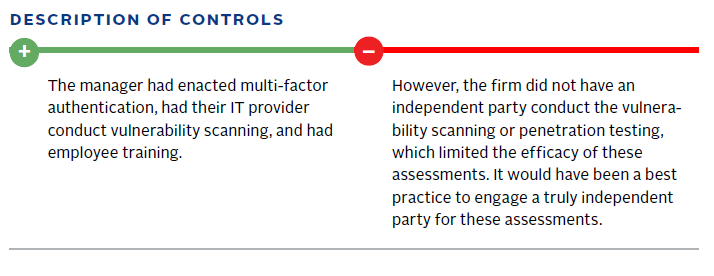
Hedge Fund 1 (HF1) had a bad actor gain access to an employee email account after the employee fell for a phishing attempt. The bad actor was able to access PII through this email account, requiring HF1 to send a notice to all investors alerting them about the breach.
Ultimately, this incident caused reputational harm to HF1 as they had to notify clients of a known breach. While there did not appear to be any misuse of client or investor PII, this incident called into question the firm’s commitment to protecting clients from cyber threats by investing in a robust cybersecurity program.