Global equities advanced in August, gaining 2.3% as resilient activity data and earnings outweighed higher bond yields. Materials, technology, and energy outperformed amid renewed AI optimism and elevated commodity prices.
- Government bond yields rose in most major markets as renewed US-Iran tensions lifted energy prices mid-month. Brent crude peaked near $95 per barrel on August 21, then ended the month at $89—little changed overall. Yields rose most in the energy-importing regions of Europe and Asia in particular.
- Fed Chair Warsh’s hawkish Jackson Hole speech added to the month-end rates repricing, prompting markets to bring forward expectations for rate hikes. Though the change in US ten-year and 30-year yields was 4 bps and -1 bps, respectively, the Treasury announced expanded long-dated bond buybacks to provide “greater liquidity support.”
- Earnings remained supportive for equities, with MSCI ACWI calendar year 2026 EPS estimates rising 2.3% during August. Nvidia’s strong results reinforced the AI investment theme, but IT leadership broadened as solid software results eased concerns that generative AI would disrupt these business models.
- Beyond IT’s 5.5% gain, materials and energy rose 9.8% and 4.1%,respectively, supported by higher metals prices, a softer dollar, and energy-supply risk. Gold rose nearly 10% as dollar weakness persisted and lower early-month rates boosted ETF demand. Central bank demand has also risen recently.
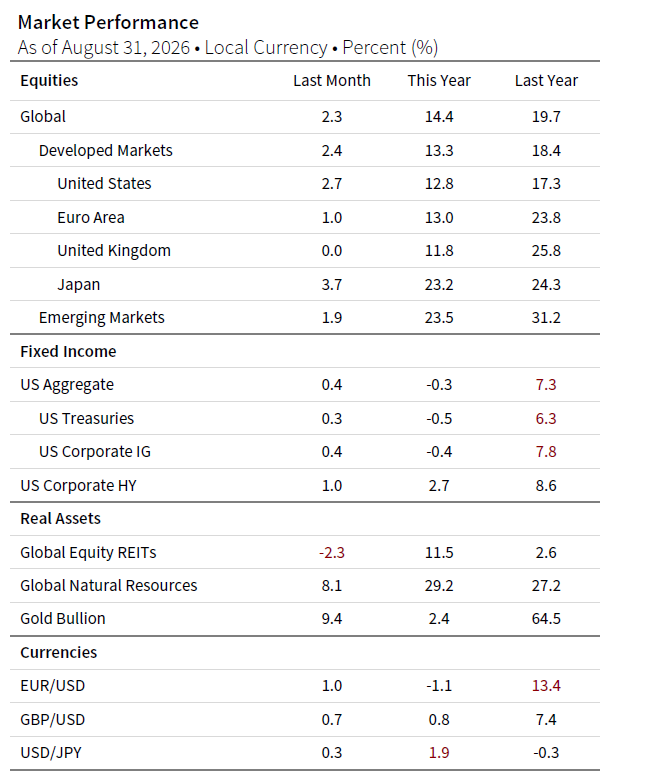
Sources: Bloomberg Index Services Limited, ICE Benchmark Administration, MSCI Inc., and Thomson Reuters Datastream. MSCI data provided “as is” without any express or implied warranties.
Notes: This edition was prepared on August 31, 2026, and it reviews developments of the prior month. The equity data are total returns net of dividend taxes of MSCI indexes in local currency. Global natural resources equities are represented by the MSCI All Country World Commodity Producers Index. The fixed income data are total returns for Bloomberg indexes. Gold Bullion uses near-month gold futures contracts, as traded on the COMEX, to determine performance. Currency performance is based on Reuters data.