As endowments grow in size and complexity, institutions think about which investment capabilities should be built internally and which are better accessed through external providers. This consideration becomes even more pronounced as investment offices navigate accelerating technology developments. Artificial intelligence and a world awash in data introduce new risks of misinformation and governance challenges. These changes reinforce the need for an intentional resource model, one that distinguishes the capabilities an institution must own from those that can be more effectively accessed through specialized external partnerships.
The “build or buy” question is sometimes framed as a stark choice between outsourcing and insourcing. In practice, the most successful model may be a hybrid that combines build and buy choices. Accessing external resources should not be regarded as a compromise or a stopgap measure on the way to full insourcing. When executed well, a hybrid model can be the most deliberate expression of institutional priorities: internal where institutional participation matters most and external when specialization, execution, or operating efficiency can be accessed more effectively through partnership.
This note discusses basic principles of investment resource decisions and outlines the key elements that should be established to develop an optimal resource model to meet the goals of a long-term investment mandate.
Establish ownership for resource decisions
The chief investment officer (CIO) is the leader of the investment program, unless the investment committee (IC) has hired an outsourced CIO or established a different structure. As the leader, the CIO is responsible for assembling the right combination of people, processes, and tools to effectively manage the portfolio and achieve investment goals. When building an investment team, the CIO has an internal perspective and relationships with organizational leadership to ensure that the investment portfolio and strategy remain aligned with the institution’s mission and objectives. It is the CIO’s job to weigh competing priorities, respond to changing circumstances, and navigate complex trade-offs. The CIO will hire internally to establish institutional ownership of the responsibilities deeply connected to the institution’s mission and success. These strategic decisions position the organization to achieve goals that extend beyond a target return and are deeply intertwined with the institution’s broader mission and long-term sustainability. The CIO will hire external resources when it is the most efficient way to access scale, expertise, and technology.
The IC is responsible for oversight of the investment program, including evaluation of investment management. While the IC will not be involved in day-to-day management, an annual review of the CIO should include insight into their management of the investment team and work with key external partners. In addition to assessment, the IC supports the CIO’s efforts to secure the best resources and get the best results for the institution. As a resource plan evolves and introduces new dynamics, a governance review can clarify the roles and responsibilities within the evolving structure and the highest and best use of time and talent of both the professional team and the IC.
Focus on resources, not staffing levels
When institutions begin to internalize more of their investment function, the first instinct is often to focus on staffing. How many people are needed? What titles should be added? Which asset classes require dedicated expertise?
These are important questions, but they should not be the starting point. Before determining headcount, an institution should first define the scope of the work, the quality of execution required, the pace at which decisions will be made, and the degree of oversight the governance structure can realistically support. In other words, the starting point is not the organizational chart. It is the resource strategy.
For institutions building their internal team, the temptation can be to measure progress as self-sufficiency. But internalization is not an end. The goal is not to build the biggest in-house team, but to create an investment model with the right resources for the organization’s needs, considering their strengths and constraints. Starting with resourcing needs instead of the organizational chart often leads to a more flexible build and buy approach as opposed to a build or buy approach.
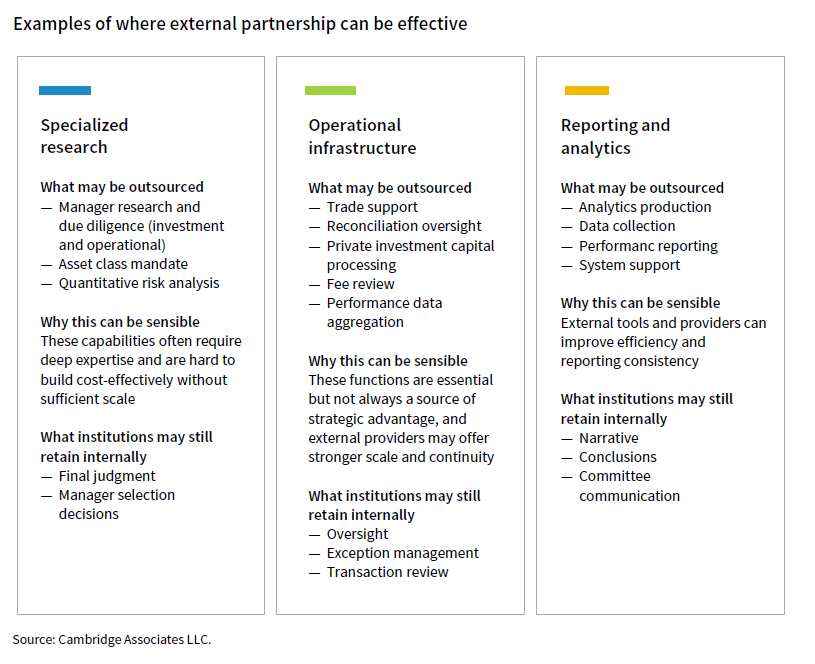
How do institutions get the right blend of internal and external resources? They focus internally on the capabilities that are most critical to the institution’s identity and decision making. These are often functions that require close alignment with mission, governance, liquidity needs, spending policy, or organizational culture. Institutions should identify where outside expertise can augment the investment team by efficiently taking on workload and expanding networks, knowledge, and development.
Move to implementation
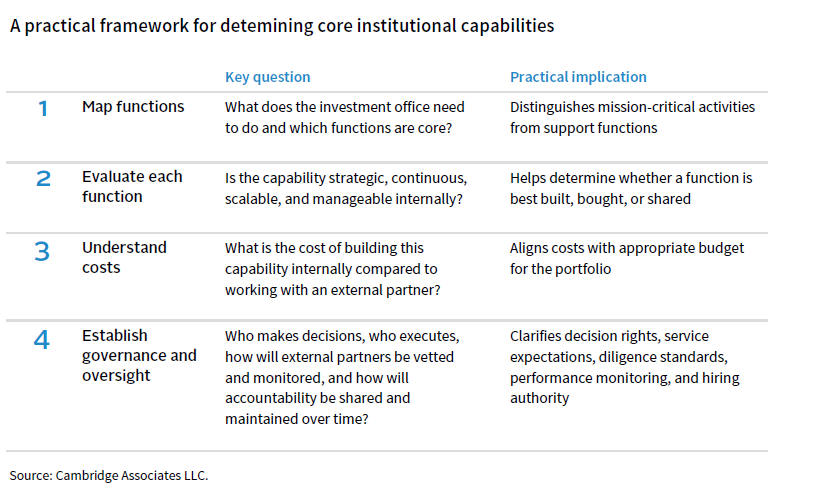
Implementing a new model requires a structured process to determine which capabilities are core to the institution, which are better accessed through external partnership, and how those choices will be governed over time. As shown in the following table, a practical framework begins with mapping the functions of the investment office, evaluating each one against consistent criteria, including costs. The proposed resources need to fit within an appropriate budget because costs matter; both underspending and overspending can weaken net performance outcomes.[1]Cambridge Associates has tracked investment management costs for endowments and foundations for 30 years and has observed the typical costs that are reasonable and sufficient to fund the investment … Continue reading
For CIOs, the use of external partners does not reduce accountability for the investment process or its outcomes. External support may extend the organization’s capabilities, but responsibility for results remains with the CIO. For that reason, authority over partner selection, oversight, and replacement should be clearly aligned with that accountability. If the CIO is expected to deliver results, the role must also carry the discretion to determine which providers are best suited to the mandate and when a relationship should change.
Build an intentional model
The most effective investment offices are not necessarily the ones that do the most internally. They are the ones designed with intention. They know where internal leadership adds value, where specialist partnership improves outcomes, and where operational discipline and investment insight matter.
This means that a thorough evaluation of an investment office is not simply a measure of headcount or autonomy, but how coherently its resources support the institution’s objectives. For CIOs, it means resisting the false choice between control and partnership. A well-designed office can achieve both.
An intentionally designed model should reflect the portfolio’s complexity, the organization’s governance capacity, the realities of hiring, and retention. It should distinguish between functions that must be owned and functions that can be accessed. It should be adaptive to incorporate new technology with appropriate skill and judgment. And it should leave room to adapt as the institution grows.
The most thoughtful strategy is an intentional one. For growing portfolios that strategy may result in a hybrid build and buy approach. Institutions that approach resourcing this way are better positioned to strengthen decision making, control costs, and create an investment office that is not only more capable, but built to evolve with the organization and portfolio.
Tracy Abedon Filosa, Head of CA Institute
Grant Steele, Managing Director, CA Institute
Footnotes